Look at the picture
The timer runs for 30 seconds.
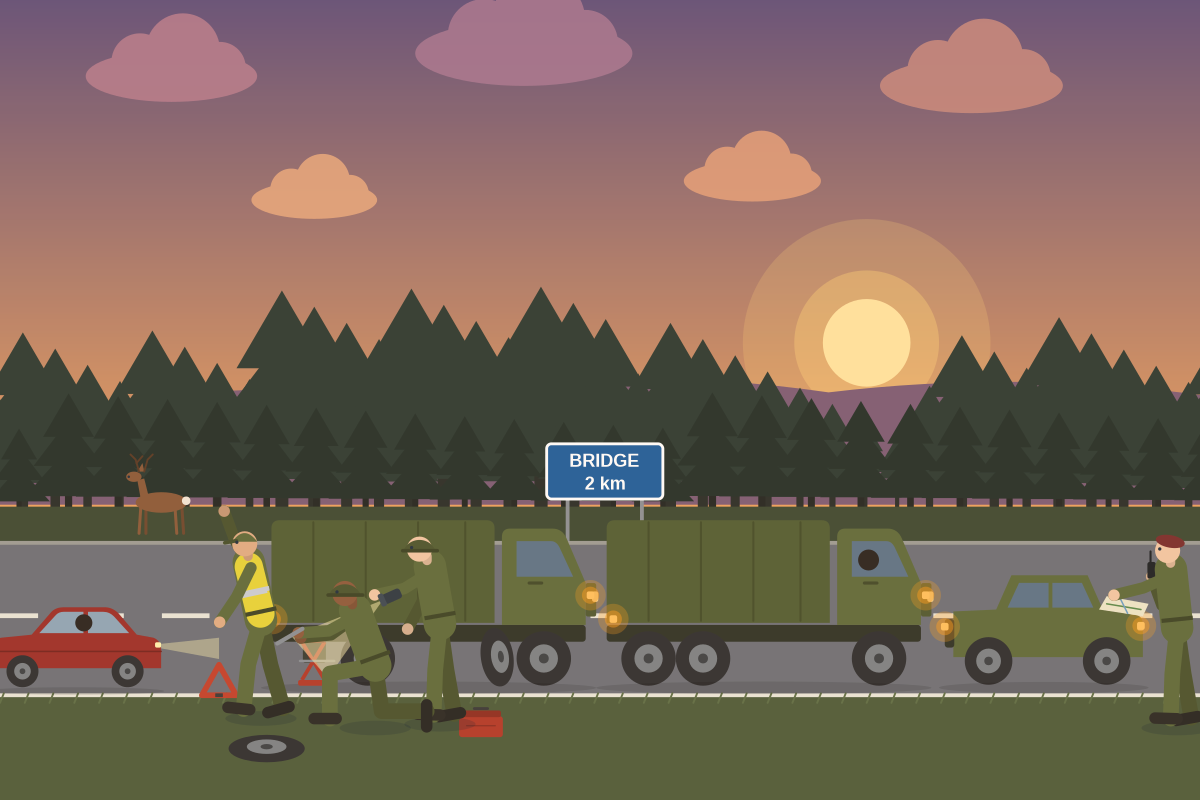
RecordingA military convoy has stopped on a forest road because a truck has a flat tire.
Get ready to speak
Words for this picture
The four parts of a description
Where is it? When? What is the weather like?
- This picture shows ...
- It looks like ...
- It is a sunny / rainy / cold day.
Who can you see? What are they doing?
- There are three soldiers.
- One of them is ...ing.
- Another one is ...ing.
What else can you see, and where?
- On the left / On the right, there is ...
- In the foreground / In the background ...
- Next to / Behind / In front of ...
What do you think is happening? What happened before? What will happen next?
- I think ... because ...
- Maybe they ... / They might ...
- Next, they will probably ...
Before and after: have done, going to. What happened before: has / have + done. What will happen next: going to, will.
Three vehicles have stopped. The convoy is going to cross the bridge.
Four sentences about this picture. Tap the right words. Then use them when you speak.
1. They ___ the wheel off the truck.
2. The sun is low. It ___ get dark soon.
3. One soldier ___ a warning triangle on the road.
4. After the wheel change, the convoy ___ drive on.
Describe the picture
1 The whole picture2 The people3 The details4 Your ideas
The timer runs for 2 minutes.
RecordingYour recording. Listen and count: how many of the four parts did you use? It is gone when you leave this page.
No word? Explain it: "the thing you use to ...", "a kind of ...". Stuck? Go to the next part.
Stuck? Questions to help you
- What time of day is it?
- What is the kneeling soldier doing?
- What is the soldier in the reflective vest doing?
- What can you see on the road sign?
Answer the questions
- Tell me about the soldiers. What is each one doing?
One soldier is kneeling at the truck with a tool, and another one is holding a flashlight on the wheel. A third soldier is standing on the road with a warning triangle, and the commander is talking on the radio.
- What do you think happened to the truck? Tell me the story.
I think the truck got a flat tire on the forest road, so the whole convoy stopped. The soldiers put the jack under the truck and took the wheel off.
- What will the convoy do next?
I think they are going to put the spare wheel on and drive to the bridge. The road sign says it is two kilometers away, so they will arrive soon, but a little late.
- Have you ever had a problem with a car or a vehicle on the road? What happened?
- Why do you think the soldier put a triangle on the road?
I think he put the triangle on the road so that other drivers slow down. The trucks are at the side of the road, and it is getting dark.
- Harder: Imagine the wheel will not come off and it is getting dark. What should the commander do, in your opinion, and why?
Asking the questions? Ask one at a time. If an answer is short, ask "Why?" or "Tell me more."
Say it again
Phrases from the model. After you speak: did you use them?
The timer runs for 1 minute.
RecordingYour first talk (2:00), to compare:
Your recording. Listen and count: how many of the four parts did you use? It is gone when you leave this page.
One thing I liked:
- you kept going
- you said where things are
- you gave a reason with because
- you used the four parts
Next time, try:
- say what you think, with "I think ... because"
- use is plus -ing for actions
- say what happened before
- explain a word you do not know
With a partner? Change roles: now you listen and ask the questions.