Look at the picture
The timer runs for 30 seconds.
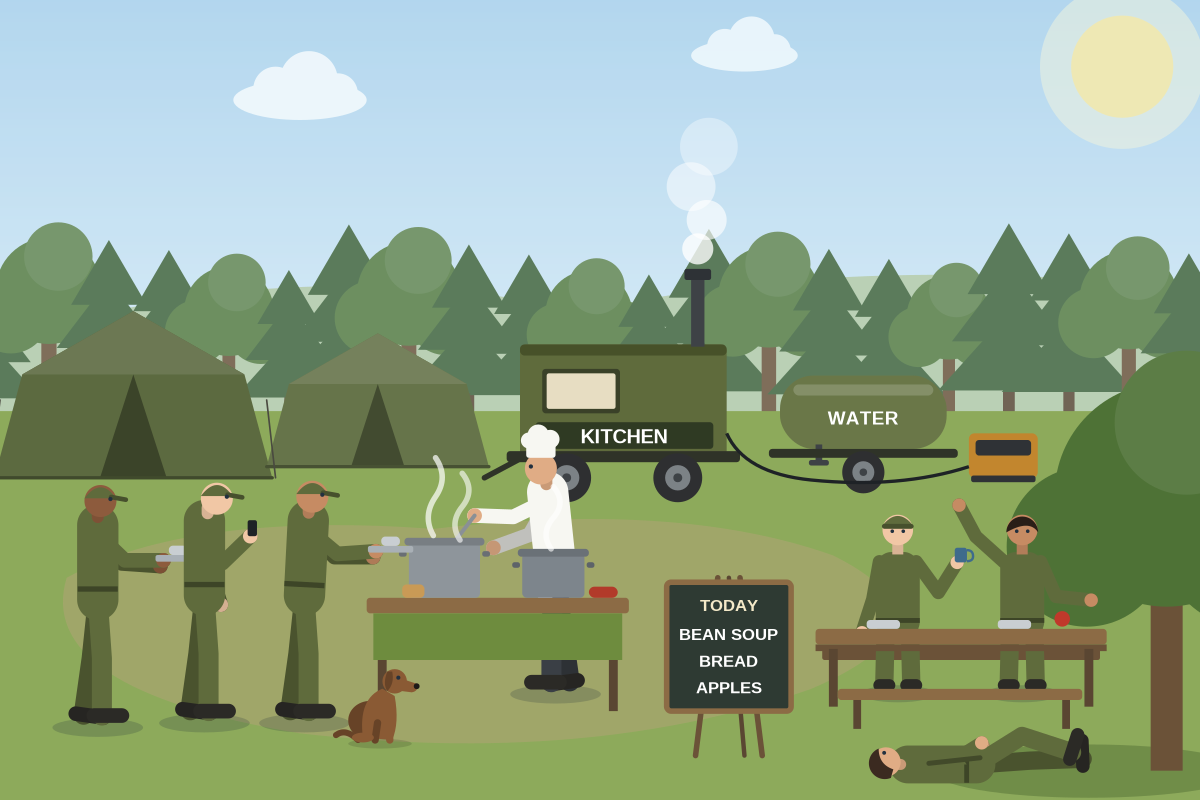
RecordingSoldiers are having lunch at a field camp on a sunny day.
Get ready to speak
Words for this picture
The four parts of a description
Where is it? When? What is the weather like?
- This picture shows ...
- It looks like ...
- It is a sunny / rainy / cold day.
Who can you see? What are they doing?
- There are three soldiers.
- One of them is ...ing.
- Another one is ...ing.
What else can you see, and where?
- On the left / On the right, there is ...
- In the foreground / In the background ...
- Next to / Behind / In front of ...
What do you think is happening? What happened before? What will happen next?
- I think ... because ...
- Maybe they ... / They might ...
- Next, they will probably ...
Where: place words. To say where things are in the picture.
In the foreground, three soldiers are standing in line. Behind them, there are two tents.
Four sentences about this picture. Tap the right words. Then use them when you speak.
1. ___, three soldiers are standing in line.
2. The cook is standing ___ the table with the pots.
3. A dog is sitting ___ the line.
4. A soldier is sleeping ___ a big tree.
Describe the picture
1 The whole picture2 The people3 The details4 Your ideas
The timer runs for 2 minutes.
RecordingYour recording. Listen and count: how many of the four parts did you use? It is gone when you leave this page.
No word? Explain it: "the thing you use to ...", "a kind of ...". Stuck? Go to the next part.
Stuck? Questions to help you
- What is the weather like?
- What is the cook doing?
- What are the soldiers on the left doing?
- What can you see on the menu board?
Answer the questions
- Tell me about the two soldiers at the table on the right.
One of the two soldiers at the table is holding a blue mug and listening. The other one has his hand up; maybe he is telling a story or asking for something.
- What do you think the soldiers did this morning, before lunch?
I think they did training this morning, maybe a long march or exercises in the forest, because they look hungry and one of them is already asleep.
- What will they do after lunch, do you think?
After lunch they will probably rest for a short time, and then they will go back to their training. The cook is going to clean the pots.
- Tell me about the food in your unit or at your work. Do you like it?
- Why do you think there is a generator at the camp?
I think the generator is there because the camp has no electricity. It gives power to the kitchen, the lights and the radios.
- Harder: Some people say good food is very important for soldiers in the field. Do you agree? Why, or why not?
Asking the questions? Ask one at a time. If an answer is short, ask "Why?" or "Tell me more."
Say it again
Phrases from the model. After you speak: did you use them?
The timer runs for 1 minute.
RecordingYour first talk (2:00), to compare:
Your recording. Listen and count: how many of the four parts did you use? It is gone when you leave this page.
One thing I liked:
- you kept going
- you said where things are
- you gave a reason with because
- you used the four parts
Next time, try:
- say what you think, with "I think ... because"
- use is plus -ing for actions
- say what happened before
- explain a word you do not know
With a partner? Change roles: now you listen and ask the questions.